
For people with chronic kidney disease (CKD), one of the first pieces of advice is to “cut back on salt.” That’s partly true—guidelines recommend limiting sodium to 2,300 mg per day or less. But the main problem isn’t the salt shaker at home—it’s the sodium hidden in processed foods, takeout, and restaurant meals. If you cook more at home and use less packaged food, a little salt can still fit into your diet. So, what is the best salt for kidney patients?
Table of contents
This post may contain affiliate links through which we may earn a small commission to help keep this website free.
Table Salt
The most common type of salt found in home kitchens and on tables is what we call table salt. One teaspoon of salt contains approximately 2300mg of sodium. Although this equals the daily goal for sodium intake, we do not recommend adding 1 teaspoon of salt per day to your food. There is naturally occurring sodium in foods, not to mention the sodium added to processed foods, so the amount that you can add at the table is far less than a teaspoon.
Salt has negligible (practically non-existent) amount of other minerals in it such as calcium, potassium, and phosphorus.
Table salt comes in two forms: iodized and non-iodized salt.
Iodized Salt
Iodized salt is salt that has had iodine added to it. Iodine is a nutrient that is required for healthy thyroid function. Without adequate iodine intake, individuals are risk of developing thyroid issues, including both hypothyroidism and hyperthyroidism. Over time, both underactive and overactive thyroid function can contribute to complications—including potential harm to the kidneys.
The daily recommended intake of iodine for adults is 150 mcg. But very few foods naturally contain iodine. In fact, during World War I, one physician found that more than 30% of the draftees he was evaluating showed signs of iodine deficiency—many severe enough to disqualify them from military service.
Voluntary salt iodization was introduced in 1924 as a simple way to prevent this widespread deficiency. Just ¼ teaspoon of iodized salt contains about 68 mcg of iodine—nearly half of an adult’s daily needs—along with about 590 mg of sodium.
For anyone choosing to use table salt, we recommend using an iodized salt to help reach your daily iodine intake goals. Since fortification is voluntary, this means that you will need to check the labels to ensure that you select an iodized salt.
What about potassium in table salt?
Many iodized salts use potassium iodide as the main source of iodine fortification. For people with kidney disease, seeing potassium listed on the ingredient list can understandably cause concern, since the potassium content of foods can vary widely—even when labels state “zero potassium” or “not a significant source.”
However, the amount of potassium added to iodized salt is, in fact, negligible. You would need to consume more than 2 teaspoons of iodized table salt to potentially equal just ONE milligram of potassium—far more salt than anyone should have in a single day. In practical terms, the potassium from iodized salt does not contribute meaningfully to your diet and is not a concern for CKD patients.
If you’re interested in learning practical ways to manage potassium without avoiding healthy, high-potassium foods (and you’re not on dialysis), you can can check out our Potassium 101 course where we walk through all of the major (and often simple!) strategies for managing potassium the right way.
Another important point: the salt used by food manufacturers for packaged, processed, or restaurant foods is almost exclusively non-iodized. This means that if most of your sodium intake comes from these sources—and you are not eating iodine-rich foods like fish, milk, or seaweed—there’s a good chance you are not meeting your daily iodine needs.
Sea Salt
Sea salt is often marketed as a healthier alternative, but nutritionally, it’s very similar to table salt.
- Sodium content: ~2,120 mg per teaspoon (slightly less only because the grains are larger)
- Taste: some chefs claim it has a “cleaner” flavor or dissolves more evenly on the tongue, but most people won’t notice a difference in everyday cooking.
- Iodine: usually not iodized unless the label says so.
Some brands also highlight that sea salt contains “natural minerals,” but the amounts are so small they don’t provide any meaningful health benefits. For example, a teaspoon of sea salt might have a fraction of a milligram of calcium or magnesium—far less than what you’d get from a sip of milk or a bite of vegetables.
Sea salt can be a nice choice for texture (for example, a coarse sprinkle over roasted vegetables or bread), but it’s generally more expensive than table salt and doesn’t offer any real nutritional advantage.
If you prefer sea salt, make sure you choose an iodized version so you don’t miss out on this essential nutrient for thyroid health.
Kosher Salt
Kosher salt is similar to sea salt in that the grains tend to be much larger. Because of this, a teaspoon of kosher salt can have as little as 1,120 mg of sodium compared to 2,300 mg in a teaspoon of table salt. The larger flakes don’t pack as tightly into a spoon, which explains the difference.
Kosher salt gets its name from the Jewish practice of koshering meat, where coarse salt is used to draw out blood. The flaky texture makes it excellent for this purpose, and many chefs also prefer it because it’s easy to pinch, sprinkle, and spread evenly over food.
If you’re following recipes that call for kosher salt, you can substitute table salt—but you’ll need to use about ½ to ¾ as much table salt to achieve the same flavor. Otherwise, the dish may taste too salty.
To my knowledge, there are no iodized kosher salts. This means if kosher salt is your primary seasoning, you’ll need to make sure you’re getting iodine from other sources such as fish, dairy, eggs, or seaweed. Without it, you run the risk of iodine deficiency, which can cause thyroid problems and even affect kidney health.
Himalayan or Pink Salt
Pink salt (sometimes called Himalayan salt) has been heavily promoted as a “healthier” alternative to table salt because it contains higher amounts of minerals such as calcium, magnesium, iron, and potassium. While this is true, the amounts found in a standard serving are still quite negligible in the grand scheme of things.
One Australian study analyzed and reported the mineral content of various pink salts. We converted their data to a teaspoon serving size and sorted the results based on the salts with the highest potassium content:
| Product Name | Calcium | Iron | Magnesium | Potassium |
| Iodized white table salt | 2.4 | 0 | 0.5 | 0.9 |
| Himalayan Pink Rock Salt with Grinder | 22.5 | 0.1 | 15.3 | 27.2 |
| Rock Himalayan Salt | 14 | 0.1 | 20.5 | 27.1 |
| Himalayan Rock Salt Crystals | 20.4 | 0.9 | 23.9 | 23.7 |
| Himalayan Crystal Salt Granules | 26.5 | 0.4 | 16.5 | 23 |
| Himalayan Pink Fine Salt | 18.7 | 0.1 | 15 | 21.1 |
| Pink Himalayan Salt | 19.6 | 0.2 | 13.6 | 20.1 |
| Pink Himalayan Rock Salt | 21.8 | 0.8 | 20.5 | 19.8 |
| Pink Himalayan Salt | 19.6 | 0.3 | 14.4 | 19.8 |
| Natural Pink Himalayan Table Salt | 17.8 | 0.3 | 12 | 19.1 |
| Himalayan Pink Rock Salt | 24.8 | 0.4 | 15.1 | 18.9 |
| Himalayan Salt Coarse | 20.3 | 0.5 | 15.2 | 18.4 |
| Himalayan Pink Fine Table Salt | 20.6 | 0.8 | 14.6 | 17.8 |
| Himalayan Salt Coarse | 17.5 | 0.6 | 17 | 17.2 |
| Natural Pink Himalayan Rock Salt | 21.5 | 0.8 | 19.6 | 17 |
| Himalayan Rock Sat | 17 | 0.5 | 15.7 | 15.4 |
| Himalayan Pink Salt Grinder | 15.6 | 0.5 | 15.4 | 15 |
| Himalayan Salt | 14.6 | 1 | 20.1 | 14.4 |
| Himalayan Crystal Salt Medium | 17.1 | 0.3 | 13.9 | 14.4 |
| Himalayan Pink Rock Salt-Fine | 13.6 | 0.5 | 14.8 | 14 |
| Pink Himalayan Salt | 10.8 | 0.3 | 8.1 | 12.5 |
| Fine Himalayan Salt | 13.9 | 0.5 | 12.7 | 11.9 |
| Himalayan Salt Fine | 8.7 | 0 | 7.1 | 10.9 |
| Himalayan Crystal Salt Fine | 11.8 | 0.6 | 15.3 | 10.8 |
| Fine Himalayan Salt | 13.6 | 0.4 | 10.9 | 9.7 |
| Natural Pink Himalayan Salt Grinder | 7.6 | 0 | 5.8 | 9.6 |
| Himalayan Fine Pink Salt | 13.5 | 0.3 | 10.2 | 8.6 |
| Pink Himalayan Salt Flakes | 10.3 | 0.1 | 5.5 | 4.7 |
| Australian Pink Lake Salt | 4.6 | 0 | 71.6 | 2 |
| Pink lake natural salt | 3.2 | 0 | 26.7 | 1.9 |
| Salt Flakes Naturally Pink | 5.4 | 0.3 | 5.9 | 0.9 |
| Fine Grain Salt | 34.4 | 0.1 | 0.9 | 0.6 |
The highest-potassium pink salt contained more than 30 times the potassium of regular table salt—but that still only equals less than 30 mg of potassium per teaspoon. This is not a meaningful contribution compared to the potassium naturally present in foods.
The same holds true for the other minerals: although calcium, iron, and magnesium are slightly higher than in white salt, they are nowhere near levels that would make a dent in daily requirements. You’d still need to get those nutrients from other foods.
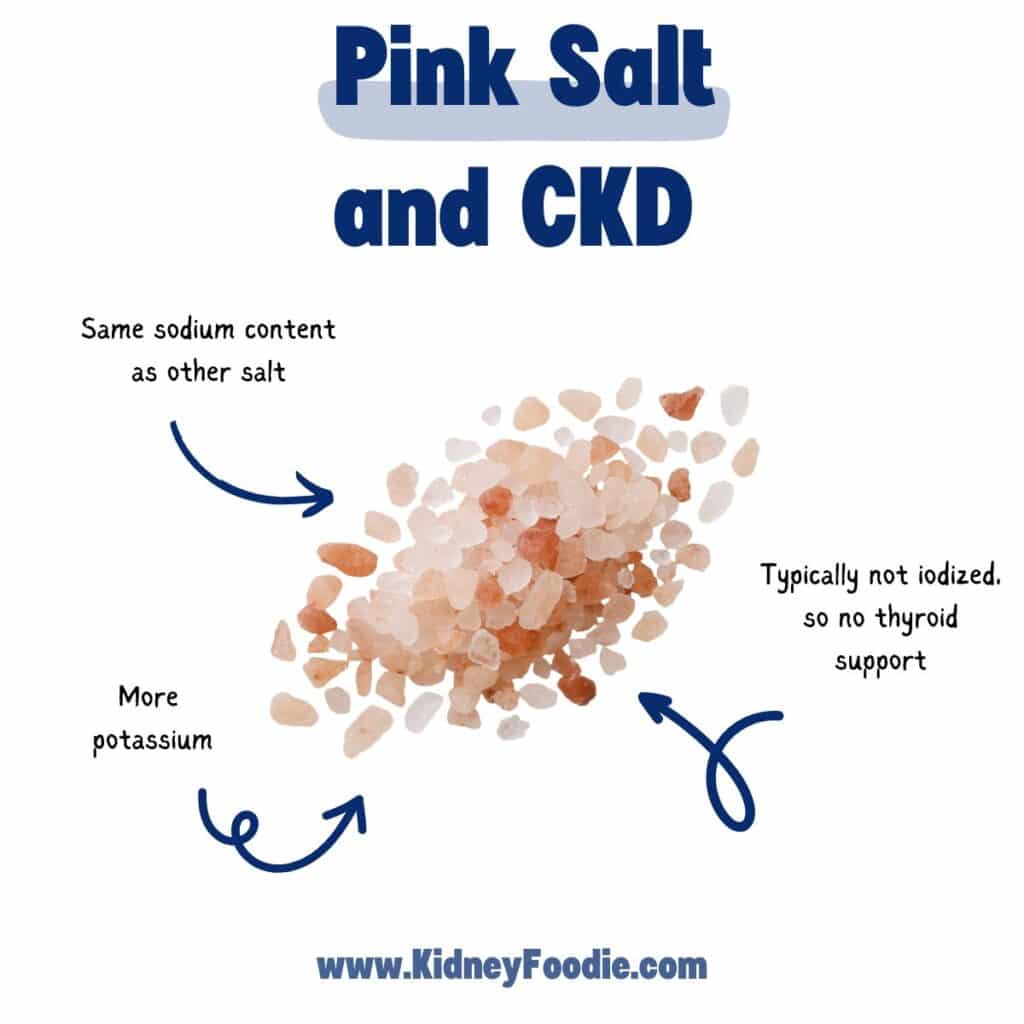
And importantly for people with CKD: pink salt does not typically contain iodine. That means relying on pink salt for seasoning can increase your risk of iodine deficiency if you aren’t eating iodine-rich foods like fish, eggs, dairy, or seaweed.
Salt Substitutes (No Salt, Nu Salt, Lite Salt)
When shopping for salt at the grocery store, you may notice some “low sodium” or “sodium-free” salts in the same aisle as table salt. Common brands include No Salt, Nu-Salt, and Morton Lite Salt. For someone trying to cut back on sodium intake, these products can look very appealing. After all, who wouldn’t want all the salty taste without the sodium?
But here’s the catch:
Most of these salt substitutes replace sodium chloride with potassium chloride. While this does reduce the sodium content, it dramatically increases the potassium content—sometimes as high as 2,760 mg of potassium per teaspoon. That’s more potassium than you’d find in six medium bananas!
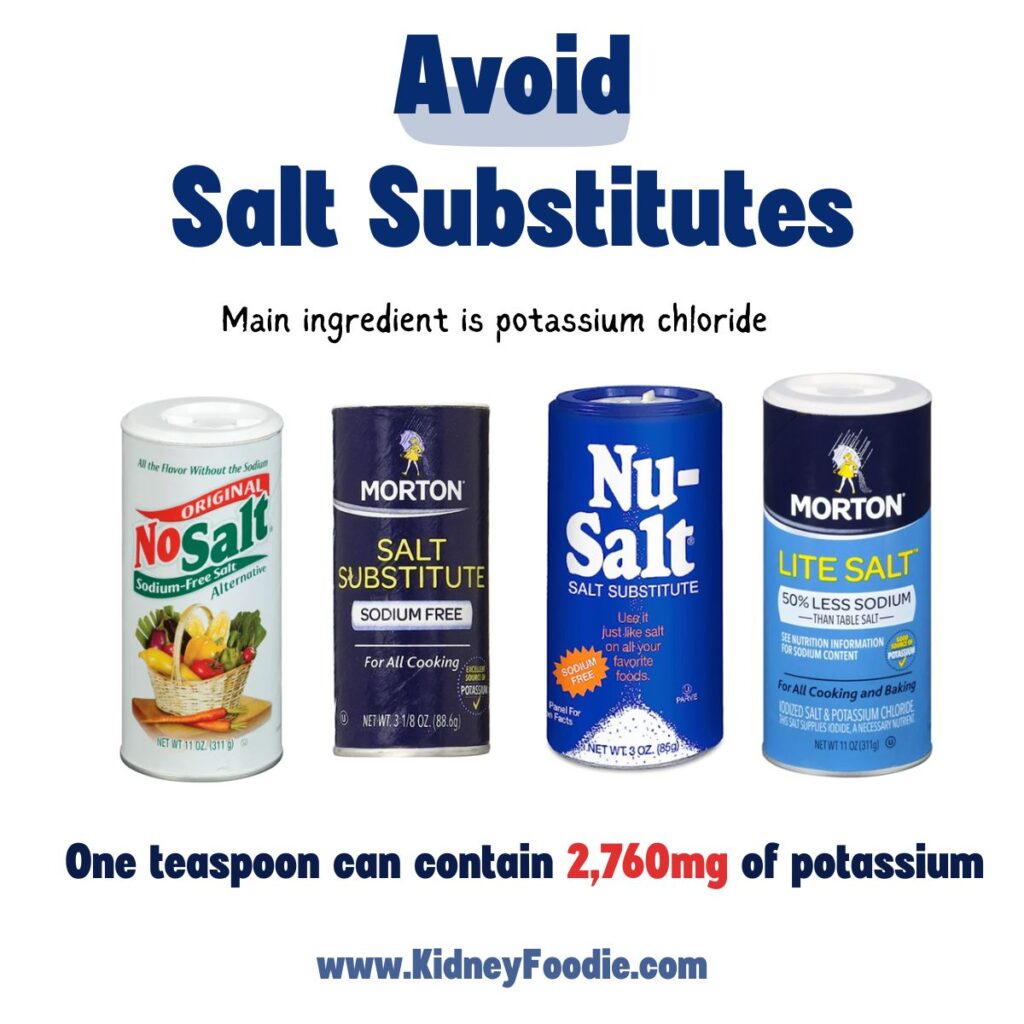
For people with CKD, this can be especially dangerous. Impaired kidney function makes it harder for the body to excrete potassium, and high blood potassium levels (hyperkalemia) can cause muscle weakness, irregular heart rhythms, and even cardiac arrest.
Unless you were specifically instructed by your doctor or dietitian to purchase one of these products, salt substitutes are not recommended for kidney patients.
So what can you use instead?
Instead of relying on potassium chloride–based products, try boosting flavor in safer ways:
- Herbs and spices: rosemary, thyme, basil, cumin, paprika, cinnamon
- Acidic ingredients: lemon juice, lime juice, vinegar (brightens flavor without sodium)
- Aromatics: garlic, onion, ginger, scallions
- Salt-free blends: look for “no salt added” seasonings (like Mrs. Dash or homemade mixes)
These not only add flavor, but also variety, so meals don’t feel bland even if you’re cutting back on sodium.
Bottom line: Salt substitutes may look like a healthy swap, but for people with CKD, the potassium load can be dangerous. Stick with small amounts of iodized salt at home, and lean on herbs, spices, and fresh ingredients for flavor.
Key takeaway
The best salt for kidney patients is one that is used in moderation—with a total daily sodium intake of less than 2,300 mg per day.
When choosing a salt for home use, iodized salt is our winner. It provides an essential nutrient (iodine) that is otherwise difficult to get in the diet, while the amount of potassium it contains is nutritionally insignificant.
Sea salt, kosher salt, and pink salt may be popular, but they generally do not typically contain iodine, and the “extra minerals” they provide are far too small to make a meaningful difference. Salt substitutes made with potassium chloride, on the other hand, can actually be dangerous for people with CKD and should only be used if specifically recommended by your healthcare provider.