
In 2016, the FDA updated its Nutrition Facts label requirements, mandating the inclusion of potassium content as one of the listed nutrients. Before this change, food manufacturers were not required to list potassium, making it difficult for people with CKD to determine how much potassium was in the foods they chose to eat. Although this requirement is beneficial, there are important nuances to consider when interpreting the information.
Table of Contents
- Why is potassium important for people with CKD?
- How much potassium do people with kidney disease need?
- What does the potassium % daily value actually mean?
- Why isn’t potassium always listed on food labels?
- Why do some food labels say that there is zero potassium, but the ingredient list contains potassium?
- What is considered high potassium on the food label?
- Key Takeaways
This post may contain affiliate links through which we may earn a small commission to help keep this website free.
Why is potassium important for people with CKD?
Potassium is an essential electrolyte that supports heart health, muscle function, and nerve signaling. The kidneys help regulate potassium levels by filtering and removing excess potassium from the body.
As kidney function declines, some individuals may experience problems keeping their potassium levels in the right range. This issue is more common in individuals with advanced kidney disease, who may need to be more mindful of their potassium intake.
How much potassium do people with kidney disease need?
There is no formal recommendation on exactly how much potassium someone with chronic kidney disease needs to eat. Potassium needs are highly individual as there are many non-food factors that can affect the amount of potassium that your body would benefit from.
A common misconception is that all individuals with CKD should limit their potassium intake to no more than 2,000 mg per day. This is not true, although I have met many individuals who have proactively decided to limit their potassium intake, despite no healthcare provider recommending such a limitation. It is important to understand that restricting your potassium intake when not necessary can also be potentially harmful.
Consult your doctor or dietitian to determine the appropriate potassium intake for your specific needs.
What does the potassium % daily value actually mean?
The Daily Value (DV) is a reference amount set by the FDA to help consumers understand how much of a particular nutrient is in a single serving of food compared to their total daily needs.
For potassium, the FDA’s Daily Value is 4,700 mg per day, which represents the amount considered adequate for most healthy individuals. However, the regulations admit that they did not consider the needs of those individuals with kidney disease when choosing this amount.
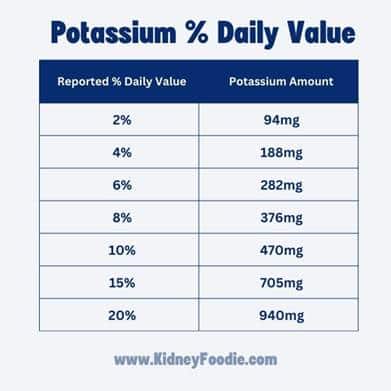
While 4,700mg is likely not the amount that most people with CKD will aim for, the labeling can still be useful in helping to determine how much potassium is in a serving of a particular food. The chart below shows the common % Daily Values and what they roughly equate to. Due to rounding, the amount of potassium listed may not always line up exactly with the % daily value.
Why isn’t potassium always listed on food labels?
Potassium is not always listed on food labels because different types of foods fall under different labeling regulations.
The FDA regulates most packaged foods including beverages, cereals, snacks, dairy products, and many other processed foods. The FDA requires potassium labeling.
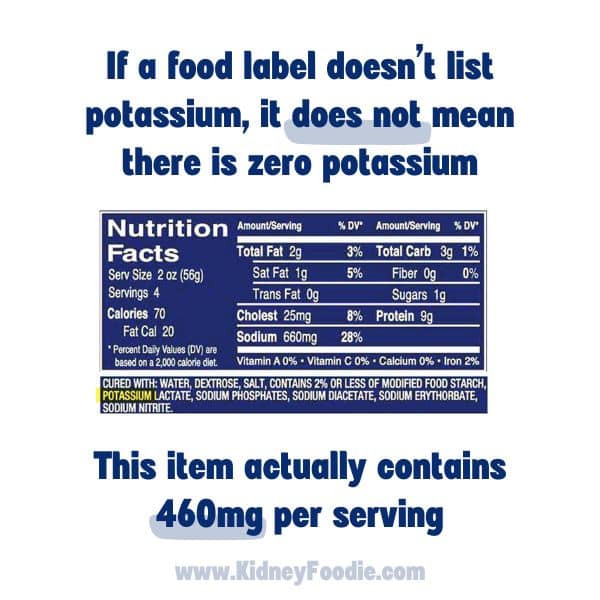
On the other hand, some foods must follow the USDA food labeling regulations, which do NOT require potassium labeling. The USDA regulates labeling for meat, poultry, and egg products, which may include potassium voluntarily but are not required to.
If a food does not list potassium on the food label, do not assume that it contains no potassium. More likely, the manufacturers simply were not required to report the amount, so it was not included. Below is an example of a pork food label:
If you do not see potassium on the food label, you may be able to get an estimate of the potassium in a food by checking certain food databases like the USDA’s Food Data Central. When reviewing the results, I recommend checking the “SR Legacy Foods” or “Survey Foods” sections first, since these will be the most likely to have a potassium amount listed.
Why do some food labels say that there is zero potassium, but the ingredient list contains potassium?
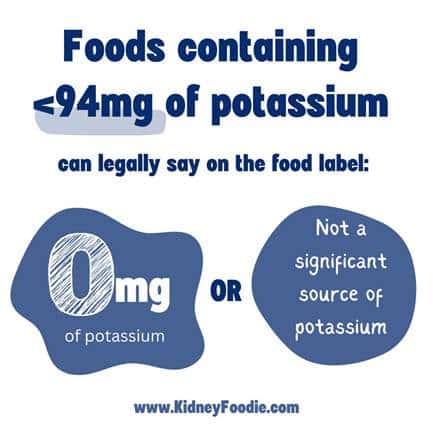
If a food contains less than 2% of the Daily Value for potassium, manufacturers are permitted to round the potassium content down to zero. Since the Daily Value is 4,700 mg, any product containing less than 94 mg of potassium per serving can legally be labeled as zero or ‘not a significant source.’
This can be very frustrating for many people with CKD. The good news is that most individuals do not need to restrict their potassium intake, so these foods containing less than 2% of the daily value are unlikely to be an issue.
If you do have elevated potassium levels and your dietitian has ruled out any non-dietary reasons for the high potassium, they may recommend cutting back on foods that contain potassium additives or being more conscientious of how many servings of these “zero potassium” foods are included in your day.
What is considered high potassium on the food label?
Since every person with kidney disease has different potassium needs, it is difficult to provide a definitive cutoff for what is considered “high potassium”. For me, the answer depends on what type of food it is.
Most packaged foods
For most packaged foods, comparing the potassium content to the calorie count can help determine whether a food is high in potassium.
- If a food has less potassium than calories, I consider it a low potassium food
- If a food has twice as much potassium as calories, I consider it a high potassium food
- If a food as more potassium than calories (but not twice as much), then I consider it a medium potassium food
Some sources suggest a more explicit cutoff of 4% Daily Value or 250 mg per serving. I’m not a big fan of this method because it makes it difficult to evaluate meals and recipes. It would be hard to find a filling meal that contained less than 250mg of potassium!
Fruits and vegetables
I tend to evaluate fruits and vegetables a bit differently. Fruits and vegetables tend to be low in calories and high in potassium. Using the definition above, most fruits and vegetables would be considered high potassium foods.
Since there are MANY reasons why someone with kidney disease would want to get in more fruits and vegetables, most healthcare practitioners use a threshold of 200mg per ½ cup serving as the cutoff for whether a fruit or vegetable is considered a high potassium food.
You can check out our Fruit and Vegetable Tool to see how much potassium is in common fruits and vegetables.
Key Takeaways
Ultimately, it is important to keep the big picture in mind when choosing foods to eat.
If you do not have a potassium restriction, then you probably do not need to be concerned about the potassium content of the foods that you eat. If you’re interested in learning practical ways to manage potassium without avoiding healthy, high-potassium foods (and you’re not on dialysis), you can can check out our Potassium 101 course where we walk through all of the major (and often simple!) strategies for managing potassium the right way.
If you do have a potassium restriction, reading food labels can be helpful in determining whether a food may be too high in potassium. Keep these following points in mind:
- If potassium is not listed at all, it does not mean that the food is low in potassium. Look up an estimate of the potassium online. If the ingredient list contains potassium, choose a version with no potassium additives.
- If a food label lists zero, keep in mind that the food could contain up to 94mg of potassium.
- Talk to your dietitian about what you should consider a high potassium food when looking at labels. Being on a potassium restriction does not mean that you can’t enjoy some high potassium foods. You may just need to be more conscientious of portion sizes and ensure that you include some lower potassium foods at other parts of your day.