
If you’ve been told to limit potassium because of kidney disease, you may have heard that beans are too high to include safely. But that’s not always true. Many beans are low in potassium, especially when you drain, rinse, or boil them properly.
And when it comes to phosphorus, beans are often a better choice than animal protein because most of the phosphorus they contain isn’t absorbed by your body. In this post, we’ll walk through which beans are best, how to prepare them, and why they may be a smart addition to your kidney-friendly diet.
Table of contents
This post may contain affiliate links through which we may earn a small commission to help keep this website free.
Health Benefits of Beans for People with CKD
Beans are one of the most underrated superfoods—especially for people with kidney disease. They’re rich in plant-based protein, fiber, folate, magnesium, iron, and antioxidants, and they come with a host of health benefits that extend far beyond just meeting your nutrition goals.
Cardiovascular and Metabolic Health
Regularly eating beans and other legumes has been shown to help lower LDL cholesterol, reduce blood pressure, and modestly improve blood sugar levels—all of which reduce the risk of heart disease and diabetes, two common complications in people with CKD. These benefits are backed by systematic reviews and randomized controlled trials, and supported by both the American Heart Association and the American Cancer Society, which recommend legumes as part of a healthy, plant-focused diet.
Beans are also low glycemic index foods, which means they digest slowly and help keep blood sugar steady—an especially important benefit if you’re living with diabetes or insulin resistance.
CKD-Specific Benefits
Beyond general health, beans also offer several unique benefits for people with non-dialysis CKD:
- Slower progression of CKD: Diets rich in plant-based foods like beans are associated with slower kidney function decline and reduced proteinuria.
- Lower dietary acid load: Plant proteins produce fewer acid-forming amino acids, which may help correct or prevent metabolic acidosis, a common CKD complication that worsens kidney function.
- Reduced inflammation and toxin load: The fiber in beans supports a healthier gut, which may lower the production and absorption of uremic toxins like indoxyl sulfate and p-cresol—compounds linked to systemic inflammation and faster disease progressio.
- Better phosphorus control: Plant-based proteins like beans contain phosphorus in a form (phytate-bound) that your body absorbs poorly—making them a lower phosphorus option than many animal proteins.
Protein with a Plant-Based Advantage
Many people with CKD are told to reduce their protein intake—but not all protein is equal. Plant proteins are less acid-producing and contain phosphorus that’s less bioavailable. Beans are an excellent way to meet your protein needs without overloading your kidneys.
A half-cup serving of beans generally contains around 6–7 grams of protein—just a fraction of what you’d get from a piece of chicken or fish. That makes them easier to portion and adjust to your individual needs.
Potassium in Beans
One of the biggest concerns with beans and kidney disease is the potassium content. Traditionally, beans are considered higher potassium foods, and many people have been told to avoid them altogether. But the truth is: how beans are prepared has a major impact on their potassium content.
In many cases, simple preparation techniques can significantly reduce potassium levels—making beans a safe and nutritious option for people with CKD.
To understand just how much of a difference preparation makes, consider the table below comparing different types of beans prepared in one of two ways:
- Boiled – These beans are cooked from dry. They’re soaked and then boiled until tender.
- Canned, drained, and rinsed – These beans are commercially prepared, and then drained of their packing liquid and rinsed in fresh water before serving.
| Per 100g serving | Calories | Protein (g) | Fiber (g) | Potassium (mg) | Phosphorus (mg) |
|---|---|---|---|---|---|
| Black Beans, boiled | 132 | 9 | 9 | 355 | 140 |
| Black Beans, canned, drained, rinsed | 118 | 7 | 7 | 253 | 91 |
| Great Northern Beans, boiled | 118 | 8 | 7 | 391 | 165 |
| Great Northern Beans, canned, drained, rinsed | 117 | 7 | 7 | 213 | 89 |
| Chickpeas/Garbanzo Beans, boiled | 164 | 9 | 8 | 291 | 168 |
| Chickpeas/Garbanzo Beans, canned, drained, rinsed | 137 | 7 | 6 | 137 | 87 |
| Kidney Beans, boiled | 127 | 9 | 6 | 405 | 138 |
| Light Red Kidney Beans, canned, drained, rinsed | 127 | 7 | 7 | 209 | 94 |
| Dark Red Kidney Beans, canned, drained, rinsed | 127 | 8 | 7 | 227 | 104 |
| Navy Beans, boiled | 140 | 8 | 11 | 389 | 144 |
| Navy Beans, canned, drained, rinsed | 119 | 7 | 7 | 184 | 87 |
| Pinto Beans, boiled | 143 | 9 | 9 | 436 | 147 |
| Pinto Beans, canned, drained, rinsed | 117 | 7 | 7 | 210 | 83 |
| Small White Beans, boiled | 142 | 9 | 10 | 463 | 169 |
| White Beans, boiled | 139 | 10 | 6 | 561 | 113 |
| Canellini Beans, canned, drained, rinsed | 115 | 7 | 7 | 203 | 95 |
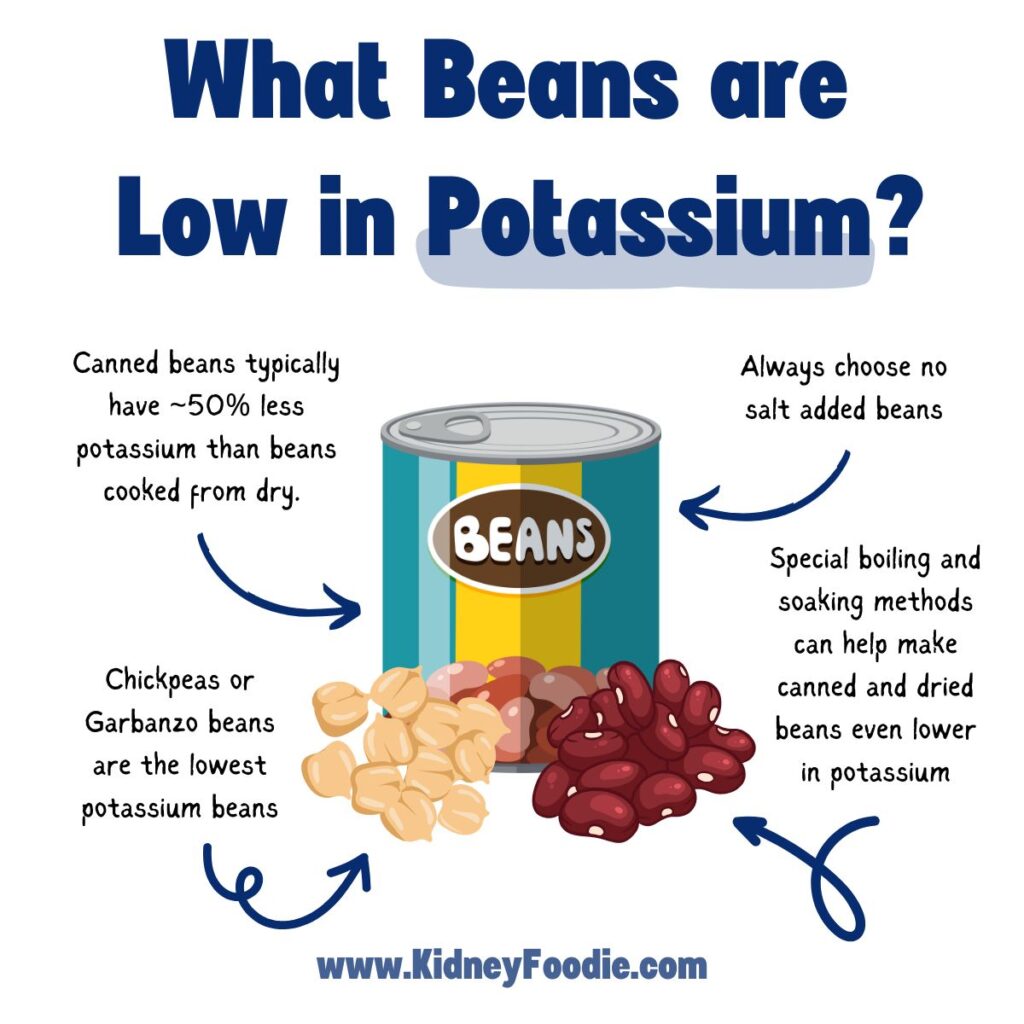
As you can see, canned beans that are drained and rinsed often contain up to 50% less potassium than boiled beans.
Note: These values are per 100g, which is a little more than ½ cup (typically around 80g).
Why Do Canned Beans Have Less Potassium?
Potassium is water-soluble. That means it dissolves in water—and the more opportunities beans have to interact with water, the more potassium they will lose.
In the industrial canning process, beans go through multiple stages where potassium leaching occurs:
- Hydration: Beans are soaked before cooking, often in warm water. This starts the leaching process.
- Cooking or blanching: Heat causes the cell walls of beans to soften and break down. This allows more potassium to move into the surrounding water.
- Storage in liquid: Beans are canned in liquid, where additional potassium moves into the packing fluid.
Draining and rinsing the beans discards the potassium-rich liquid, lowering potassium even further.
By contrast, when beans are cooked at home from dry, they are usually soaked once and then cooked in the same water. That water (and the potassium it contains) often stays with the beans.
How to Lower the Potassium in Beans
If you’re cooking dried beans and want to reduce potassium further, here’s how:
- Soak beans overnight in cold water. Drain and rinse.
- Cook with a generous amount of water—at least 1.5 liters per 100g of beans. The more water, the more potassium leaches out. One study that achieved potassium levels as low as 68mg per 100g used this exact method.
- Optional: Halfway through cooking, drain the water and replace it with fresh water. This creates a new, potassium-free environment for additional leaching.
- Drain and rinse the final product. Store cooked beans in water if not using immediately. They will continue to leach potassium if stored in liquid.
For 1lb of beans (~450g), you’ll need at least 1.8 gallons (28 cups) of water. It’s a lot—but worth it if potassium is a concern.
For canned beans, the process is easier:
- Soaking canned beans in fresh water for 12 hours (using 1.5 liters per 100g) reduced potassium by over 80% in one study.
- Simmering canned beans for 30 minutes in water dropped potassium by ~70%.
- Doing both reduced potassium to just 6mg per 100g of chickpeas!
These results were most dramatic in chickpeas and lentils, but similar effects are likely with other types of beans.
Why does soaking cooked beans work, but soaking dried beans doesn’t? Raw beans have intact cell walls that trap potassium inside. Once beans are cooked (or canned), those barriers are broken down—allowing potassium to escape more easily into water.
What Beans Are Low in Potassium?
If you stick to canned, drained, and rinsed varieties, many common beans already fall below the 200mg per serving threshold often used to define “low potassium.”
Here’s a comparison based on a ½ cup (80g) serving:
| Per 80g/1/2 cup serving | Calories | Protein (g) | Fiber (g) | Potassium (mg) | Phosphorus (mg) |
|---|---|---|---|---|---|
| Chickpeas/Garbanzo Beans, canned, drained, rinsed | 110 | 6 | 5 | 110 | 69 |
| Navy Beans, canned, drained, rinsed | 95 | 5 | 5 | 147 | 69 |
| Canellini Beans, canned, drained, rinsed | 92 | 6 | 5 | 162 | 76 |
| Light Red Kidney Beans, canned, drained, rinsed | 102 | 6 | 6 | 167 | 75 |
| Pinto Beans, canned, drained, rinsed | 94 | 5 | 6 | 168 | 66 |
| Great Northern Beans, canned, drained, rinsed | 94 | 6 | 6 | 170 | 71 |
| Dark Red Kidney Beans, canned, drained, rinsed | 102 | 6 | 6 | 182 | 83 |
| Black Beans, canned, drained, rinsed | 94 | 6 | 5 | 202 | 73 |
And here’s how those same beans compare when boiled from dry:
| Per 80g/1/2 cup serving | Calories | Protein (g) | Fiber (g) | Potassium (mg) | Phosphorus (mg) |
|---|---|---|---|---|---|
| Chickpeas/Garbanzo Beans, boiled | 131 | 7 | 6 | 233 | 134 |
| Black Beans, boiled | 106 | 7 | 7 | 284 | 112 |
| Navy Beans, boiled | 112 | 6 | 9 | 311 | 115 |
| Great Northern Beans, boiled | 94 | 6 | 6 | 313 | 132 |
| Kidney Beans, boiled | 102 | 7 | 5 | 324 | 110 |
| Pinto Beans, boiled | 114 | 7 | 7 | 349 | 118 |
| Small White Beans, boiled | 114 | 7 | 8 | 370 | 135 |
| White Beans, boiled | 111 | 8 | 5 | 449 | 90 |
Conclusion: If you’re watching potassium, opt for canned beans that have been drained and rinsed. If you want to enjoy other types, use the soaking and cooking methods above to help reduce potassium even further.
Do You Need to Limit Potassium?
Not necessarily! Many people with CKD still have adequate kidney function to process normal amounts of potassium from food. If your blood potassium levels are in the normal range and your doctor or dietitian hasn’t told you to cut back, you probably don’t need to.
In fact, unnecessarily avoiding potassium-rich foods can be harmful. Potassium helps regulate blood pressure, nerve function, and muscle contractions—and many potassium-rich foods are rich in other beneficial nutrients too.
If you are concerned about potassium or wish to take steps to ensure that potassium does not become an issue for you in the future, you can can check out our Potassium 101 course where we walk through all of the major (and often simple!) strategies for managing potassium the right ways.
If you do need to reduce potassium, canned beans and the cooking methods listed here can help you safely enjoy beans without exceeding your limit.
Phosphorus in Beans
Are Beans High in Phosphorus?
When you look at the total phosphorus content of beans, it might raise some eyebrows. A 100-calorie portion of beans can contain anywhere from 59 to 140 mg of phosphorus. And because phosphorus is closely linked to protein content, it’s no surprise that protein-rich foods like beans often contain more phosphorus than, say, fruits or vegetables.
But here’s the key: not all phosphorus is created equal.
Beans contain phosphorus in a form called phytate (or phytic acid)—a compound that humans can’t digest very well. In fact, the majority of the phosphorus in beans is not absorbed by your body. This is what dietitians refer to as “low bioavailability.”
Phosphorus Bioavailability from Beans
While animal-based sources of phosphorus (like meat or dairy) may be absorbed at rates of 40-60%, plant-based sources like beans are absorbed at much lower rates—around 10-50%.
Here’s a look at the actual phosphorus content of various beans, adjusted for their estimated absorbability of 30%. These values are based on a ½ cup (80g) serving:
| Per 80g/1/2 cup serving | Protein (g) | Phosphorus (mg) | 30% Bioavailable |
|---|---|---|---|
| Black Beans, boiled | 7 | 112 | 34 |
| Black Beans, canned, drained, rinsed | 6 | 73 | 22 |
| Great Northern Beans, boiled | 6 | 132 | 40 |
| Great Northern Beans, canned, drained, rinsed | 6 | 71 | 21 |
| Chickpeas/Garbanzo Beans, boiled | 7 | 134 | 40 |
| Chickpeas/Garbanzo Beans, canned, drained, rinsed | 6 | 70 | 21 |
| Kidney Beans, boiled | 7 | 110 | 33 |
| Light Red Kidney Beans, canned, drained, rinsed | 6 | 75 | 23 |
| Dark Red Kidney Beans, canned, drained, rinsed | 6 | 83 | 25 |
| Navy Beans, boiled | 6 | 115 | 35 |
| Navy Beans, canned, drained, rinsed | 6 | 70 | 21 |
| Pinto Beans, boiled | 7 | 118 | 35 |
| Pinto Beans, canned, drained, rinsed | 6 | 66 | 20 |
| Small White Beans, boiled | 7 | 135 | 41 |
| White Beans, boiled | 8 | 90 | 27 |
| Canellini Beans, canned, drained, rinsed | 6 | 76 | 23 |
How Do Beans Compare to Animal Protein?
To put this in context: a similar 7g protein portion of chicken breast contains about 67mg of phosphorus, with about 60% of it absorbed—that’s around 40mg of absorbable phosphorus.
Even worse, some animal products are enhanced with phosphate additives to preserve moisture or improve shelf life. That same 7g of protein from enhanced pork could contain 100mg of phosphorus or more—with nearly 100% absorption.
When you look at it from this angle, beans are often lower in absorbable phosphorus than their animal-based counterparts, making them a smart choice for people trying to manage phosphorus levels.

Which beans are bad for kidneys?
Some canned beans—especially flavored varieties like baked beans—may contain phosphorus additives. These are inorganic phosphate salts added for texture, flavor, or preservation. Your body absorbs nearly 100% of this type of phosphorus.
Always check the ingredient label for words like “phosphate,” “phosphoric acid,” or “polyphosphates.”
Does Soaking or Cooking Reduce Phosphorus?
To a small extent, yes—but not as dramatically as potassium.
While phosphorus is technically water-soluble, it doesn’t leach out as readily. Soaking or boiling beans might reduce total phosphorus content by 10–20mg per 100g serving—a modest change.
That said, because only a small portion of phosphorus in beans is absorbed in the first place, these reductions may not be clinically significant.
If you’re concerned about your phosphorus levels, a better strategy is to limit foods with phosphorus additives (like processed meats, soda, and shelf-stable baked goods), rather than avoiding beans.
Tips for Choosing Canned Beans
When shopping for canned beans, a few smart choices can make a big difference in keeping your potassium, phosphorus, and sodium intake in check:
1. Choose “No Salt Added” beans whenever possible. Sodium adds up quickly in canned goods, and many varieties of canned beans contain 300–500mg of sodium per serving. “No salt added” versions help you stay under the recommended sodium limit of 2,300mg per day for people with kidney disease.
2. Be cautious with “Reduced Sodium” or “Low Sodium” beans. These often still contain significant sodium and may use potassium chloride as a salt substitute. That means the sodium might be lower—but the potassium could be much higher. Always check the ingredient label for any potassium-containing additives (look for words like “potassium chloride”).
3. Stick with plain, unseasoned beans. Flavored or pre-seasoned beans (like chili beans or baked beans) are more likely to contain phosphorus additives and higher levels of sodium and sugar. These additives are nearly 100% absorbed and can quickly increase your phosphorus load.
4. Drain and rinse canned beans thoroughly. This simple step can reduce potassium by 30–40% and remove some residual phosphorus and sodium from the packing liquid. Rinsing also helps eliminate any added preservatives or flavors lingering in the liquid.
5. Read ingredient labels carefully. Look for short, simple ingredient lists—ideally just the bean variety, water, and salt. Avoid any product with phosphate, phosphoric acid, or potassium-based preservatives in the ingredients.
Making these changes doesn’t mean sacrificing flavor—you can season plain beans yourself with herbs, spices, and healthy oils that fit your kidney-friendly meal plan.
Kidney Friendly Canned Beans You Can Buy
Eden Organic No Salt Added Pinto Beans
Eden Organic No Salt Added Garbanzo Beans
Eden Organic No Salt Added Black Beans
Eden Organic No Salt Added Cannellini Beans
Eden Organic No Salt Added Butter Beans
Westbrae Organic No Salt Added Lentils
365 Whole Foods Market No Salt Added Organic Cannellini Beans
365 Whole Foods Market No Salt Added Organic Black Beans
365 Whole Foods Market No Salt Added Organic Kidney Beans
365 Whole Foods Market No Salt Added Organic Garbanzo Beans
365 Whole Foods Market No Salt Added Dark Red Kidney Beans
365 Whole Foods Market No Salt Added Pinto Beans
365 Whole Foods Market No Salt Added Black Beans
365 Whole Foods Market No Salt Added Garbanzo Beans
Great Value No Salt Added Dark Red Kidney Beans
Great Value No Salt Added Black Beans
Great Value No Salt Added Light Red Kidney Beans
Great Value No Salt Added Pinto Beans
Great Value No Salt Added Chili Beans